Deck the Halls With Stolen Logins: The 2026 Holiday Scam Field Guide
Between November 12 and November 22, Microsoft 365 went dark for most of a day, the FAA stopped every departing flight in the country for about four hours, AWS had a rough morning in us-east-1, Chase customers couldn't get into their accounts, Apple tripped over one of its own updates, PlayStation Network wobbled the day before GTA VI launched, and Delta's Atlanta flights sat on the ground during Thanksgiving week. As far as anyone has said publicly, none of it was a cyberattack. That's the good news.
The less good news is that scammers don't need to cause an outage to cash in on one. They need a lot of people, a reason for those people to expect a message, and a clock. The holidays deliver all three, wrapped, with a bow on top. So this is our field guide to the season. It covers what broke, what the scammers did with it, what's actually new this year, why GTA VI might be the most dangerous "free download" on the internet right now, and the ten-second habit that beats most of it.
The holidays are an airport, and the scammer is wearing a hi-vis vest
Think about an airport the Wednesday before Thanksgiving. It's loud, it's crowded, and everyone is half-listening for the one announcement that matters to them. If someone in a hi-vis vest points down the concourse and says your gate moved, most of us probably just walk where they point. We don't ask for ID. The vest is the credential.
The holiday season puts all of us in that terminal for six weeks. We're expecting packages, so a delivery text feels normal. We're traveling, so a toll notice or a flight change seems plausible. We're buying gifts from stores we've never used, so an unfamiliar site with a great price doesn't set off the alarm it would in March. Norton's 2026 holiday report found that 16% of the 1,000 Americans it surveyed had been scammed while shopping online over the holidays, with an average loss of $394 (Norton via PR Newswire). That's one vendor's survey, not a census, but it seems to line up with most of what we read this month.
Here's where the analogy stops working, and it matters. At the airport, the person in the vest is almost always an employee. Online, the vest costs nothing. A brand logo, a sender name, a service alert, a familiar voice and the top search result are all just vests now, and most of them can likely be bought or generated in minutes.
The scam doesn't have to be good. It has to be on time.
Two weeks, one string of lights
If you grew up with the old style of holiday lights, you remember the ritual. One bulb dies, the whole string goes dark, and somebody spends an hour pulling bulbs one at a time to find the bad one. Those strings were wired in series, so every bulb depended on every other bulb. I'd argue a lot of modern infrastructure behaves the same way, and the last two weeks were a live demonstration.
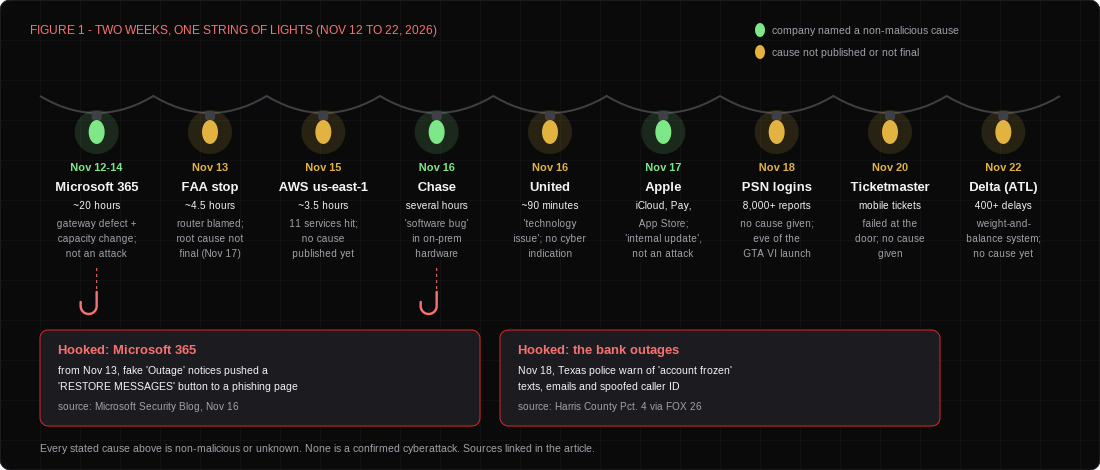
Microsoft's outage started on November 12 and ran about 20 hours by ThousandEyes' count. Microsoft traced it to a hidden defect in gateway servers, made worse by a traffic change and maintenance that cut capacity, and said it was not caused by a cyberattack (Wikipedia's summary of BBC, Guardian and SecurityWeek reporting; Network World). The next afternoon the FAA issued a nationwide ground stop that lasted roughly four and a half hours (Wikipedia). Transportation Secretary Sean Duffy blamed newly installed routers flooding the system with connection attempts, but as of November 17 Reuters reported that no root cause had been found (Reuters).
Then it kept going. AWS lost eleven services in us-east-1 for a few hours on November 15, including IAM Identity Center sign-in, and, as far as we could tell, had not published a post-event summary as of November 21 (The Register). Chase went down on November 16, with more than 20,000 Downdetector reports by mid-afternoon, and blamed a software bug in on-premise hardware (Fortune). United's departures stalled for about 90 minutes the same day (CBS News). Apple said an internal update knocked out several of its services on November 17 and that it was not a cyberattack (AP via ABC7). PSN logins failed for thousands of players on November 18 (GV Wire), Ticketmaster's mobile tickets stopped working at venue doors on November 20 (WAFB), and today Delta's weight-and-balance system failed badly enough that the FAA held Atlanta-bound flights at Delta's request (Simple Flying).
None of these is a confirmed attack. From the outside, each one seems to be the kind of failure every operations team has nightmares about, a change that went sideways or a dependency nobody remembered. We should not read a conspiracy into a bad week. We should read a dependency map.
The outage was not the attack. It was the pretext.
Microsoft first saw a high-volume phishing campaign on November 13, the day after its own outage began. The emails posed as service-health alerts, used subjects like "Outage" followed by a random string, claimed that held mail would be deleted within 24 hours, and offered a big "RESTORE MESSAGES" button (Microsoft Security Blog). Field Effect saw the same theme, plus fake Microsoft support staff offering refunds and texts claiming the sender's email was down so please pay this new account instead (Field Effect). That last one is plain old payment fraud wearing an outage costume, and it probably works better than it should because the outage was real.
After the bank outages, the Harris County Precinct 4 Constable's Office in Texas warned residents about texts, calls and emails claiming their accounts were frozen, some with spoofed caller ID (FOX 26). And on November 20, a separate vendor breach exposed names and emails of some Chase, Visa and Mastercard customers. Chase says it's unrelated to the outage (BleepingComputer), which is probably true and doesn't help much, because a fresh list of bank customers' emails landing the same week as a bank outage is a phisher's dream.
During an outage, there are exactly two sources of truth, the company's status page and the company's own app. Nobody fixes an outage by emailing you a login button.
Even the real stores had a rough month
This is the uncomfortable part, because there is no tell. On November 16, attackers injected malicious JavaScript into scripts hosted by Optimizely, a web experimentation platform that likely sits on more retail pages than most shoppers would guess. Report URI found 188 infected scripts across 178 organizations, and the code could skim card numbers (including the CVV), swap crypto wallet addresses and deliver iOS exploits. Optimizely confirmed a vulnerability was exploited and says it's fixed. Named sites include IKEA, Ledger and Peacock (Help Net Security). Other lists of "affected" brands are circulating, but those are potentially affected sites, not confirmed breaches (Newsweek). The number of skimmed cards is unknown. My working assumption is that the real list of affected sites is longer than the public one, because a skimmer that works is a skimmer that stays quiet.
Revolve, meanwhile, disclosed that saved card numbers, expiry dates, names and addresses were exposed in a September incident, with Texas alone listing 127,200 affected residents. The total is likely larger, but Revolve hasn't confirmed a number (Malwarebytes).
Think about what that means for the shopper. You typed the address yourself. You went to a real store. A third-party script you've never heard of read your card number as you typed it. Spotting fakes probably doesn't help here at all. What helps is making a stolen card number worth less. Use a credit card rather than a debit card for online shopping (in the US, credit cards generally come with stronger dispute protections), use virtual card numbers if your bank offers them, and turn on alerts for every transaction, large or small.
If you run an e-commerce site, this is exactly the problem PCI DSS v4.0 requirements 6.4.3 and 11.6.1 were written for. Inventory and authorize every script on your payment pages, and detect when one changes (PCI Security Standards Council). A script you load is code you run. It just happens to be someone else's code.
The 2026 naughty list
The classics are all back, and most of them have been to the gym.
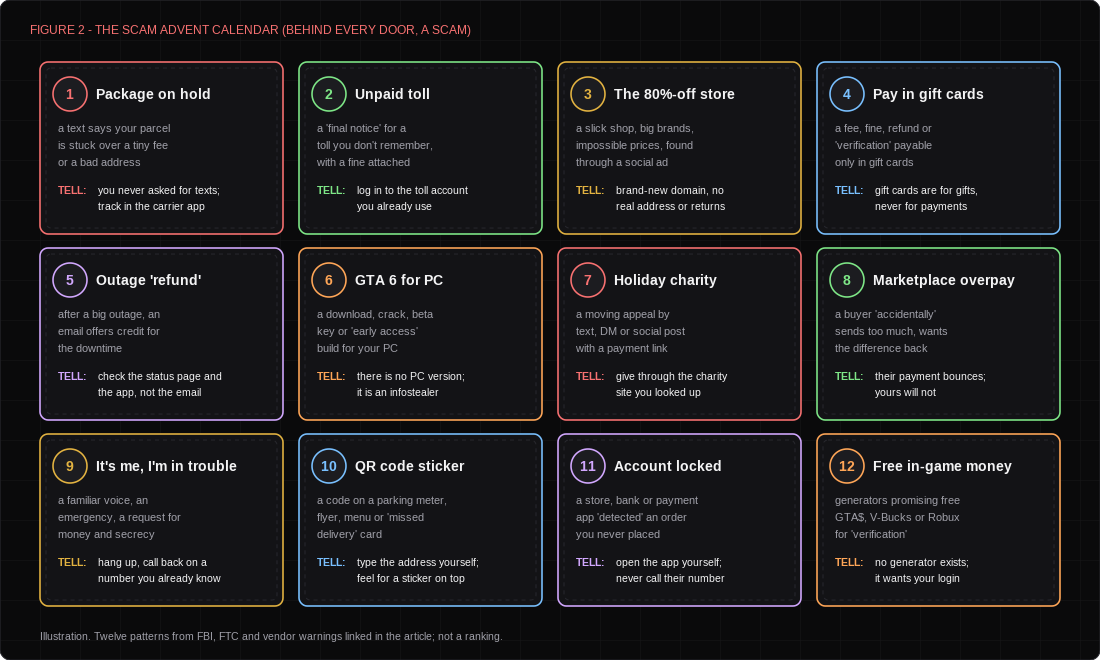
The numbers from this month are hard to ignore, and I suspect most of them undercount, since each vendor only sees what its own sensors see. Check Point counted more than 4,000 new sale-themed domains between October 1 and November 8, rated nearly one in five of them risky, and found 647 FedEx look-alike domains, along with a site called walmartrollbackdeals.com offering a $49.99 iPad (Check Point). Bitdefender says half of the Black Friday-themed spam it saw was outright scams, and it caught a fake Nike store being promoted through a paid TikTok ad (Bitdefender). KnowBe4 saw Black Friday scam detections jump 260% in the first week of November alone (KnowBe4).
The FTC's November 19 alert focuses on something many people still might not expect, which is scam ads sitting right at the top of search results next to the real stores. Its advice is boring and correct. Scroll past the paid ads, search the company's name with "complaint" or "scam," and type addresses you already know (FTC). The FTC's own data suggests why ads matter. People reported losing $2.1 billion to scams that started on social media in 2025, shopping scams were the most reported type, and over 40% of those victims bought something from an ad (FTC).
The package that doesn't exist
The delivery text is the fruitcake of holiday scams. Nobody asked for it, it shows up every year, and somehow it never goes away.
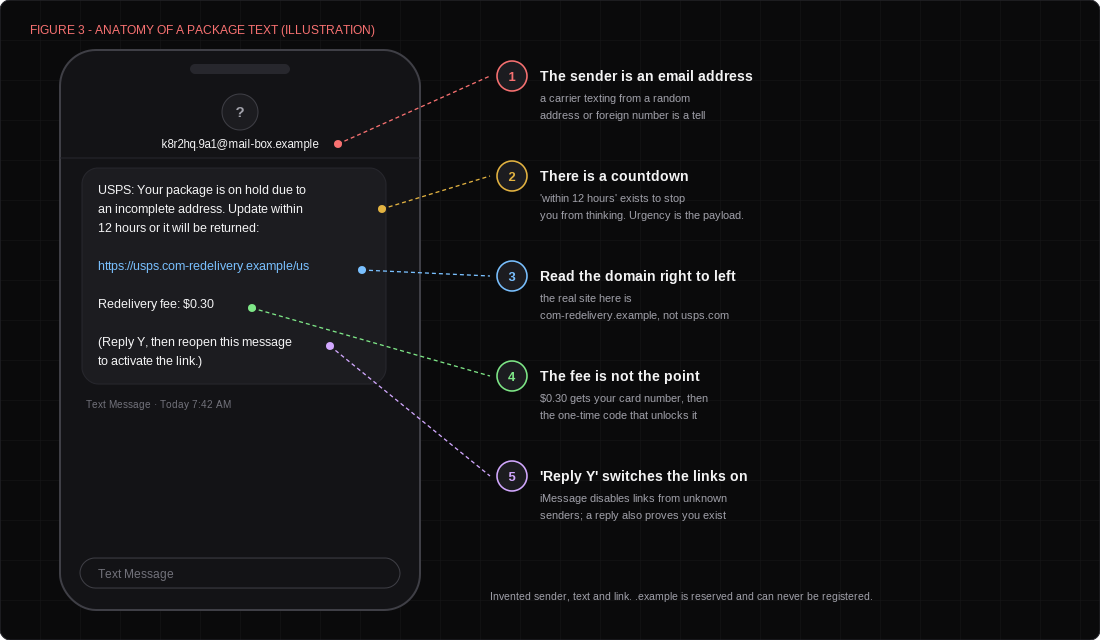
A few things about that text are worth knowing. The US Postal Inspection Service says USPS won't text or email you unless you first requested updates with a tracking number, and those messages won't contain a link (USPIS). The "Reply Y" line isn't decoration either. iMessage disables links from unknown senders, and replying switches them back on while also confirming your number is live, a trick researchers flagged in early 2025 (Malwarebytes). The tiny fee isn't the point. Switzerland's NCSC describes parcel lures asking for customs fees as small as CHF 1.50 (Swiss NCSC), because the real prize is most likely your card number and, a moment later, the one-time code that lets them use it.
That second step is where the kits have quietly gotten scarier. Group-IB described a kit called JWR that records your keystrokes live and gives a human operator 32 scripted steps, including asking you for one-time codes as you go (SecurityOnline on Group-IB's research). It seems less like a fake website and more like a call center with a web front end. The operators aren't amateurs, either. In June, Google sued the group it calls "Outsider Enterprise," a judge granted a restraining order citing more than 100,000 victims, and Google says the operators used its own Gemini model to build fake "gift redemption" pages (BankInfoSecurity). That's perhaps the most awkward product feedback of the year.
What's actually new this year
Most holiday scams are decades old. What changed in 2026 is the engine underneath them.
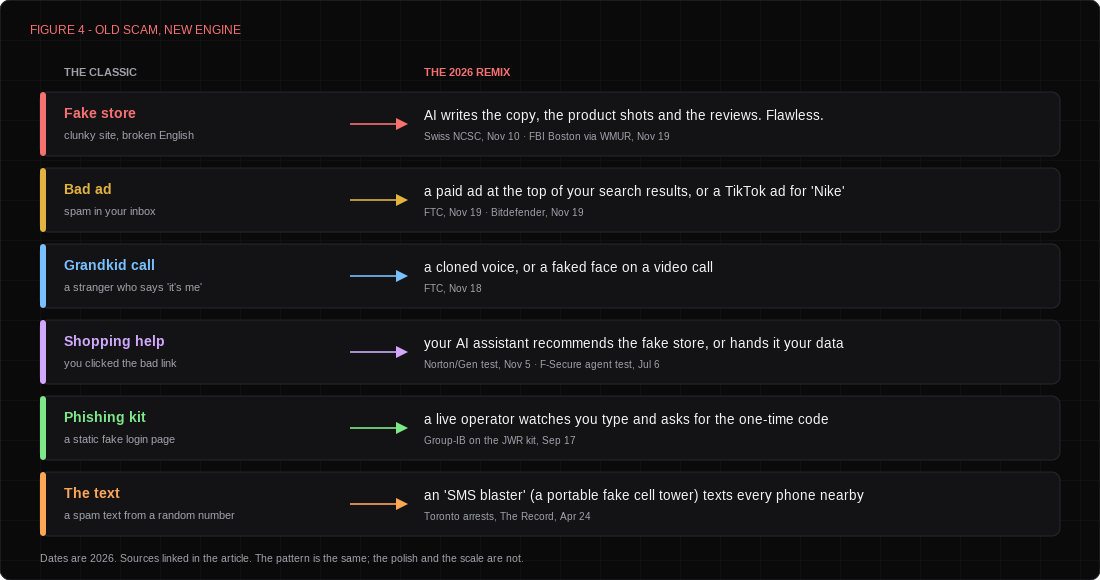
The typos are gone. Switzerland's NCSC says AI-generated fake shops now come with flawless text, product photos and fake reviews (Swiss NCSC). An FBI official in Boston told WMUR that criminals are using AI to build sites that copy real ones, and that about 230 people in New Hampshire alone lost more than $2.5 million to these scams last year (WMUR). For twenty years we told people to look for bad grammar. I think that advice has quietly expired. The typo was never a security control. It was a gift from lazy criminals, and they've stopped giving it.
Your shopping assistant can be scammed for you. Norton says 63% of the people it surveyed have used an AI shopping assistant, and in one of its lab tests an assistant recommended a $279 jacket from a fraudulent store without any warning (Norton via PR Newswire). F-Secure went further. It built a test shopping agent, hid a prompt injection inside a product review, and watched the agent submit a user's name, date of birth and Social Security number to a phishing page in 12 of 100 runs, almost never telling the user it had done so (F-Secure). That's one lab test of one agent, so we should not conclude that every assistant fails one time in eight. It suggests the failure mode is real, not that the rate is. Banks warned about this in September (CNBC), and Visa now calls misuse of AI agents a developing threat (Visa).
My read
An agent that can browse and pay probably inherits every scam you'd fall for, plus one more, because a web page can now talk to it directly. The scammer no longer has to fool you. They have to fool the thing you delegated to. If you let an assistant shop for you this year, keep checkout approval in your own hands and give it a virtual card with a low limit. We covered how prompt injection works in How Attackers Attack AI.
The voice on the phone may not be who it sounds like. The FTC's November 18 alert on grandkid scams is blunt. "Some scammers use digital tools to create fake videos or clone your loved one's voice" (FTC). The fix is low-tech. Hang up, call back on a number you already have, and agree on a family code word before anybody needs one.
The cell tower might be the scammer. In April, Toronto police arrested three men over an "SMS blaster," a device that pretends to be a cell tower, and The Record reported that tens of thousands of phones connected to it and received texts posing as banks and government agencies (The Record). Carrier spam filtering likely does very little when the tower your phone is talking to belongs to the scammer.
Your loyalty points are money, and attackers know it. Kasada says about 30% of the stolen accounts it saw for sale held loyalty points, and it expects account-takeover peaks around November 16 to 23 and December 24 to 27 (Kasada). In most cases, I'd guess airline miles and retailer points sit behind an old password and nothing else. Give those accounts a unique password and turn on MFA where it's offered.
And in a sign of the times, the Treasury Department's holiday advisory warns that scammers are now using "super intelligence (SI)" (Treasury). I've read a lot of fake toll notices this month. "Super" is doing a lot of work in that sentence.
GTA VI is the gift that keeps on stealing
Grand Theft Auto VI launched on November 19 on PlayStation 5 and Xbox Series X|S (PlayStation Blog), and Take-Two estimates $3.79 billion in day-one retail sales (Take-Two). Rockstar has announced no PC version, no beta, no demo and no early access. The real game costs $79.99 for Standard or $99.99 for Ultimate in the US (ESET).
That one fact does most of the defensive work for you. There is no PC version. Every "GTA 6 PC download," crack, repack, cloud client and beta key on the internet right now is, at best, a waste of time, and far more likely malware.
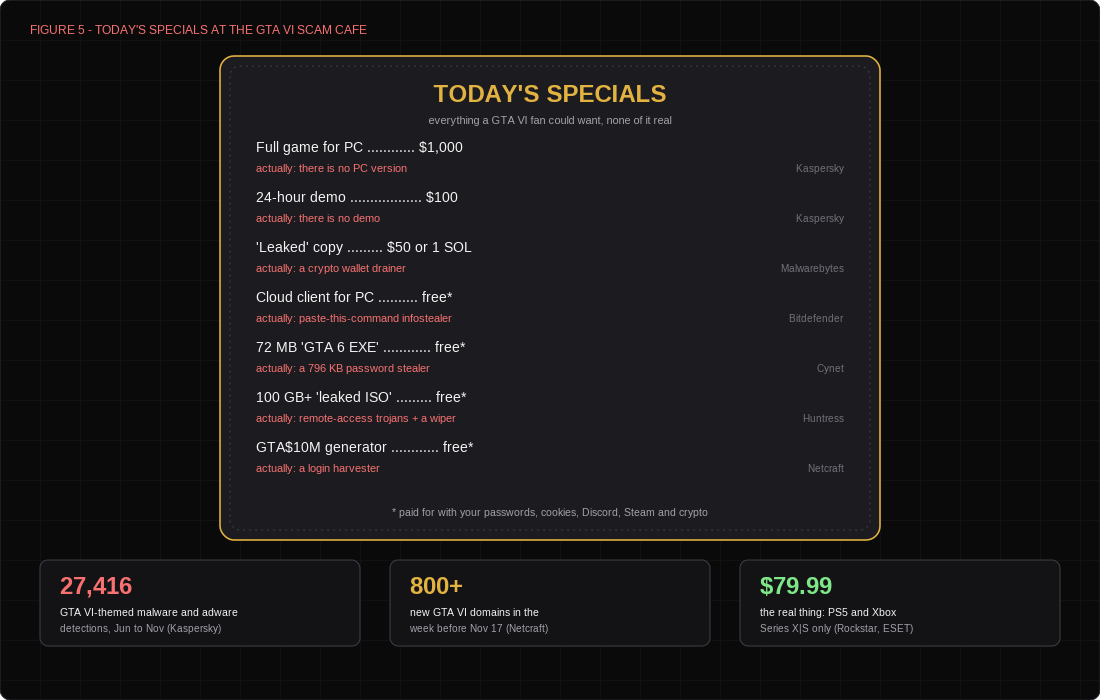
The research is piling up faster than the patch notes. Kaspersky counted 27,416 detections of GTA VI-themed malware and unwanted apps between June and November (Digital Trends), and earlier found fake shops charging $1,000 for the "full game" and $100 for a "24-hour demo" (Kaspersky). Netcraft tracked about 140 new GTA VI domains a week from July to October, then at least 800 in the single week before November 17, including a near-perfect clone of Rockstar's support site and a "money generator" promising up to GTA$10 million (Netcraft).
The most interesting one, technically, is Bitdefender's November 20 report on a fake "cloud client" that promises to stream the game to your PC. It uses a technique called ClickFix, which tells you to paste a PowerShell command to "install" the client. While a decoy trailer plays, it side-loads a DLL that injects a Rust-based infostealer, which goes after browser passwords and cookies, Discord and Steam accounts, crypto wallets, clipboard contents, screenshots, and even AI and developer API keys (Bitdefender Labs). ClickFix is clever in an annoying way. You do the breaking in yourself, so a lot of security tools likely see a user running a command rather than malware arriving. (If stolen API keys sound familiar, we wrote about what happens next in Your API Key Was Someone Else's Credit Card.)
The rest of the menu is just as creative. Cynet found a Google Colab notebook linking to a "GTA 6 EXE" advertised at 72 MB that was really a 796 KB password stealer, with a README telling users to run it as administrator and add an antivirus exclusion (Help Net Security). A 796 KB file claiming to be a game that needed up to 212 GB just to pre-load? The math does not work. Huntress found "leaked" ISOs padded past 100 GB to look legitimate, carrying remote-access trojans and Chaos ransomware that behaves as a wiper (Help Net Security). Malwarebytes has documented a "leaked copy" for $50 or 1 SOL that was really a crypto wallet drainer (Malwarebytes), plus fake Android apps uploaded more than 1,700 times under 90-plus names and a couple of GTA-branded crypto tokens (Malwarebytes).
Why the kid's gaming PC is everybody's problem
Infostealers don't just take passwords. They take session cookies, which can let an attacker replay a logged-in session and skip both the password and the MFA prompt. In a lot of homes, I suspect the gaming PC is also where someone checked the bank, the family email and, occasionally, a parent's work account. So when a teenager "just tries" the PC beta from a YouTube comment, the realistic blast radius is probably the whole household's logins, not one Steam account.
If that has already happened, assume every password saved in that browser is stolen. From a different, clean device, change the important passwords (email first, then banking), sign out of all sessions everywhere you can, move any crypto to a new wallet, and rotate any API keys or developer tokens that lived on that machine. Then wipe and reinstall the PC rather than trusting that an antivirus scan found everything, because it might not have.
Buying it as a gift
ESET points out that parents and relatives are less likely to know which GTA VI products are real, and it expects fake gift cards and bundles to show up as holiday lures, with Black Friday landing on November 27 (ESET). Physical boxes contain a download code rather than a disc, which makes them easy to resell, and PS5 codes are region-locked (Notebookcheck), and there are scattered reports of sealed boxes missing their codes, though it seems to be uncommon (Notebookcheck). Buy from a retailer you already know, or buy digital directly from the PlayStation Store, Microsoft Store or Rockstar's store. Keep the receipt. And if a seller wants crypto or gift cards for a "discounted" copy, you've found the scam, not the deal.
One more for the corporate crowd. KnowBe4 says gaming-related phishing rose 1,300% over its March to August average, GTA lures made up 42.4% of the phishing emails it processed on October 31 and November 1, and some posed as a free GTA VI "employee perk" with QR codes and look-alike domains that passed SPF, DKIM and DMARC (KnowBe4). Email authentication tells you which domain sent a message. It doesn't tell you the domain is honest.
Ten seconds that beat most of this
Here's the good news. You don't need to memorize every scam in this post. Most of them likely collapse under three questions.
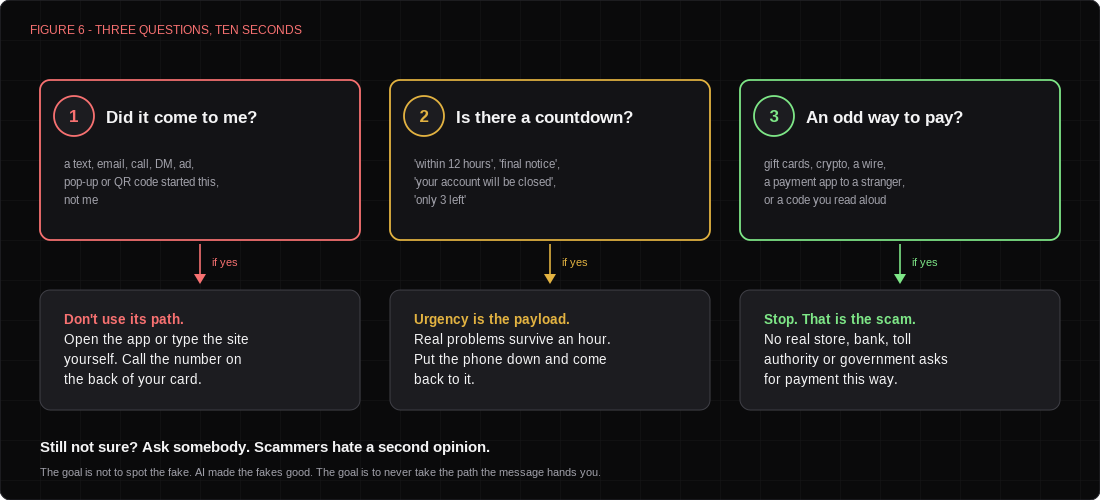
The first question does the heavy lifting. If a message, call, ad, pop-up or QR code started the interaction, don't use the path it gave you. Open the app, type the address, or call the number on the back of your card. The second question catches the clock, and real problems can probably survive an hour. The third catches the payment. No real store, bank, toll authority or government agency wants gift cards, crypto, a wire, or a one-time code read aloud over the phone.
If you already clicked, don't spiral. Call your bank using the number on your card, change the password you typed from a different device, and turn on MFA if it wasn't on. Report it at reportfraud.ftc.gov and ic3.gov, and forward scam texts to 7726 so your carrier can flag the number. Then tell someone, because being embarrassed is exactly what the scammer is counting on.
If you run a security team
The holidays are a stress test for your users and your help desk at the same time. A few things are worth doing this week.
- Pre-write the outage notice. The moment a major provider goes down, tell users that IT will never send a "restore" link and that any payment-change request needs a phone call to a known number. Microsoft's lure campaign started the day after its outage began, so the notice has to be faster than that.
- Treat personal-device infostealers as an identity risk. Stolen session cookies from a home PC can replay a work SSO session. Shorter session lifetimes, session binding where your identity provider supports it, and alerts on session reuse from new networks all likely help.
- Audit your payment-page scripts. After Optimizely, check what third-party JavaScript runs on checkout pages and whether you'd notice it change. PCI DSS 6.4.3 and 11.6.1 are probably a reasonable place to start even if you're not a merchant.
- Retire "look for typos" from your awareness training. Teach the path rule instead, because it still works when the email is perfect.
Send this to the family
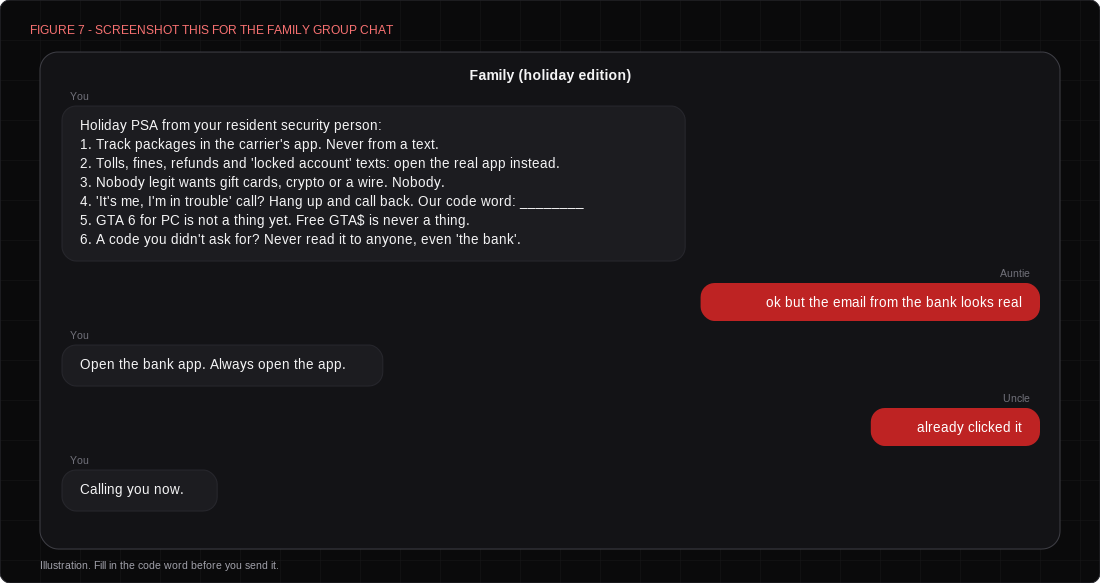
Every year somebody in the family becomes the IT department between the turkey and the gift wrap. If that's you, here's your group chat message, pre-written.
The vest is the vulnerability
Look back at every scam in this post and you'll find the same move. The scammer hands you a path, whether that's a link, a number, a QR code, a download, a "restore" button or a store your assistant recommended, and counts on you to take it because it showed up wearing the right vest. Outages make the vest more convincing. AI makes it cheaper. Agents may soon take the path on your behalf without asking.
The defense that survives all three isn't better fake-spotting, because the fakes are now good. It's an architectural habit, the same one we'd recommend to any security team. Don't trust the channel the request arrived on. Verify through a channel you already control. That works for a package text, a cloned voice, a perfect phishing email and a hijacked shopping agent, and it will probably work for whatever shows up next December too.
Happy holidays. Track your packages in the app, call Grandma back on the number you already have, and if your nephew swears he found a working GTA VI PC beta on YouTube, he didn't. He found an infostealer with a very good trailer.

Founder · Dr. Chaos
Aamir Lakhani is a leading senior security strategist responsible for providing IT security solutions to major enterprises and government organizations. He creates technical security strategies and leads security implementation projects for…