Kimi K3 and K3 Swarm: An Open-Weight Model Review from the Red Team Chair
Every red team I know has the same quiet conversation eventually. You are three days into an engagement, the model you have been leaning on for recon summaries and code review suddenly decides your perfectly authorized work looks suspicious and starts refusing, and you are left staring at a "I can't help with that" from a vendor who is also, by the way, logging every prompt you just sent about your client's internal network. That moment is when a lot of operators start looking hard at open weight models, and lately the name that keeps coming up is Kimi.
Moonshot AI's Kimi line has spent the last couple of years doing something the frontier labs mostly will not: shipping large, genuinely capable models with the weights out in the open, tuned hard for agentic work and tool use. Kimi K3, and the multi agent configuration people are calling K3 Swarm, are the current expression of that. This is a review of both from a cybersecurity standpoint. Not "is it smart," but the question a red team actually asks: does this thing make me more effective on an engagement, and what does it give me that Claude and GPT cannot.
I want to be balanced here, because a review that only lists advantages is marketing. Kimi K3 is very good at some things and genuinely behind on others, and where it wins for offensive work has almost nothing to do with raw intelligence and almost everything to do with control.
Set the expectations first: this is a moving target
One honest caveat before anything else. The model landscape moves faster than anyone can publish, benchmarks age like milk, and the exact numbers you see quoted for any of these models will be wrong by the time you read them. So I am not going to hand you a table of scores and pretend it is gospel. I am going to tell you where these models fit, how to think about them for security work, and how to evaluate them yourself on your own tasks, which is the only benchmark that has ever mattered.
If you take one methodological point from this article, make it that last one. Do not trust my benchmarks or anyone else's. Build a small evaluation set of the tasks you actually do on engagements and score the models on those. Everything below is meant to tell you where to point that evaluation.
What Kimi K3 and K3 Swarm actually are
Kimi K3 is a large mixture of experts model with open weights. The mixture of experts design matters for practical reasons: the model is enormous in total parameter count but only activates a fraction of itself for any given token, so it punches at a high capability tier while being cheaper to run than its raw size suggests. Moonshot has consistently aimed the Kimi line at agentic behavior, long context, and tool use rather than pure chat, which is exactly the profile that matters for security automation.
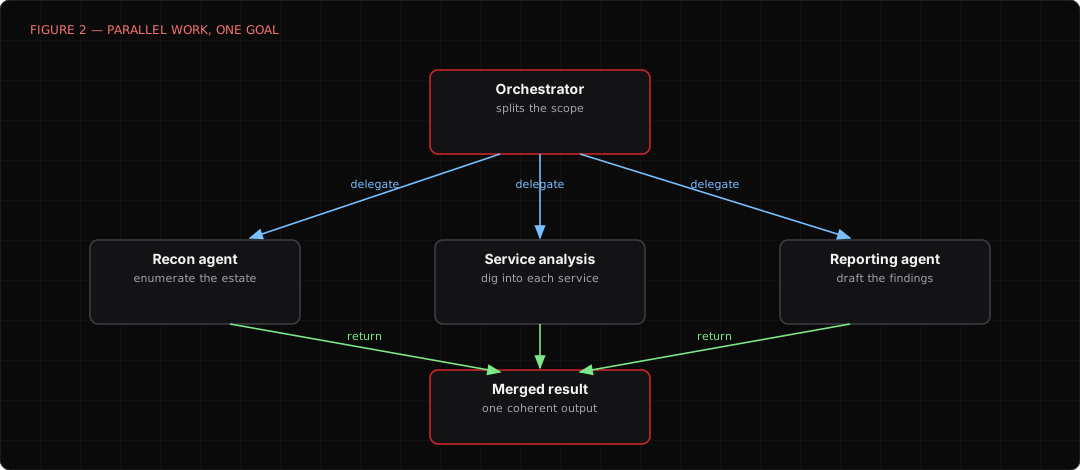
K3 Swarm is not a different model so much as a different way of deploying the same one. It is a multi agent orchestration pattern where several instances of the model run in parallel, each given a role, coordinated by an orchestrator that splits the work, farms it out, and stitches the results back together. One agent enumerates, several dig into different services at once, another writes up findings, and a controller keeps them pointed at the goal. The appeal for offensive work is obvious the moment you say it out loud: a lot of what a red team does is embarrassingly parallel, and a swarm eats parallel work for breakfast.
Why a red team cares, and it is not what you think
The instinct is to assume operators want open models so they can strip the safety filters and generate attack tooling the commercial models refuse. That happens, and we will deal with it honestly in a moment, but it is not the main event. The real advantages are boring, operational, and far more important on a professional engagement.
Your data stays in the room
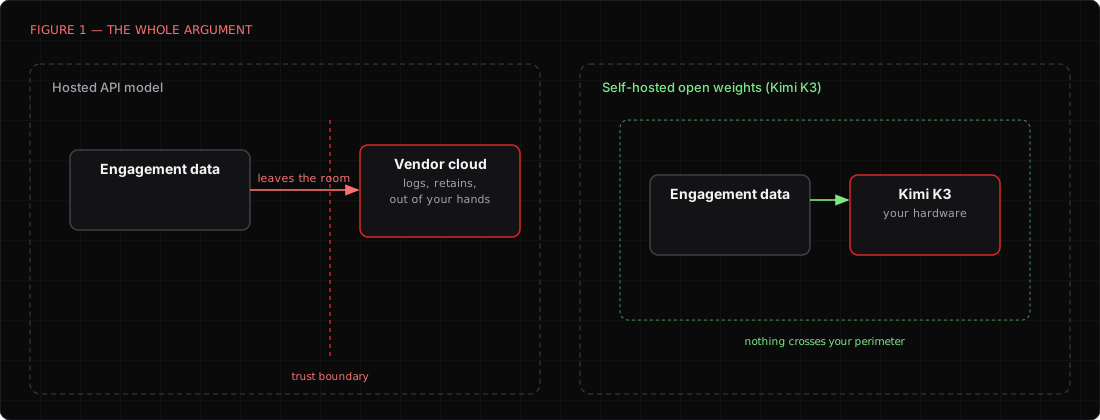
This is the big one, and it is a genuine dealbreaker for serious work. When you send a prompt to a hosted commercial model, your client's internal hostnames, their vulnerability details, their source code, their network layout, all of it crosses a trust boundary to a third party who logs it, retains it, and is subject to legal processes you have no control over. For a lot of engagements, particularly anything touching regulated data, classified environments, or a client with a hard contractual line about where their data may go, that is simply not allowed. A model you run yourself, on hardware you control, inside the client's own network if need be, means the sensitive material of the engagement never leaves the perimeter. That single property is why open weights win a category that raw capability cannot.
No account holding your engagement hostage
Commercial models come with usage policies, rate limits, and the standing possibility that an automated system flags your entirely legitimate work and cuts you off mid engagement. When your workflow depends on a vendor who can throttle or ban you at the worst possible moment, you have built your operation on someone else's permission. Self hosting removes that dependency completely. The model is yours, it answers when you ask, and no trust and safety system is going to lock you out at hour seventy two of a seventy two hour window.
Cost at the scale automation actually runs
Per token pricing is fine when a human is in the loop typing one prompt at a time. It stops being fine the moment you point a swarm at a large scope and let it run thousands of automated analyses across a big estate. High volume, automated security work is exactly the usage pattern that makes metered pricing painful, and it is exactly where owning the model and the hardware turns a variable bill that scales with your ambition into a fixed cost you already paid.
You can teach it your world
Open weights mean you can fine tune. A team can take the base model and train it on their own tooling, their own reporting format, their client's specific technology stack, or a corpus of their past engagements, and get a model that speaks their dialect. You cannot do that to a model you can only reach through an API. For a mature team with a body of internal knowledge, this is how a general model becomes your model.
The swarm fits the work
Reconnaissance, service analysis, log triage, and evidence gathering are all naturally parallel. A single model in a chat window does them one at a time. A swarm does them all at once, with a controller keeping the effort coherent, and then hands you a merged result. For the kind of broad, shallow first pass that opens most engagements, throwing many coordinated agents at the scope is a genuinely better shape than a single sequential conversation, and the open orchestration frameworks make it something you can actually build rather than just admire.
The part we are not going to pretend around
Yes, an open weight model can be fine tuned or prompted past the safety alignment that commercial models enforce, and yes, that is part of why some people reach for them. An operator can get a self hosted model to write things the aligned commercial versions would refuse. I am not going to write a how to for that, and I am going to be clear about the line, because it is the line between a profession and a crime.
Authorized red teaming, with a signed scope and a client who asked for it, is legitimate work, and using whatever tooling makes you effective inside that scope is fine. Using the same capability outside a scope, against systems you were not invited to touch, is an offense, and the model being open changes nothing about that. The tool does not launder the intent. A self hosted model that will generate an actual weaponized payload on demand is a real thing that exists, and treating it as anything other than a serious responsibility is how people end up explaining themselves to someone with a badge. Use the capability the way you would use any powerful, dual use tool: inside the authorization, and never outside it.
WARNING
An uncensored, self hosted model removes the vendor's guardrails, not the law. The signed scope of your engagement is the only thing that separates authorized testing from a computer crime, and the model's willingness to answer has no bearing on whether you were allowed to ask. Keep the paperwork, and stay inside it.
Where Kimi K3 is genuinely behind
A fair review says the uncomfortable parts too. Open weights buy you control, and control is not free.
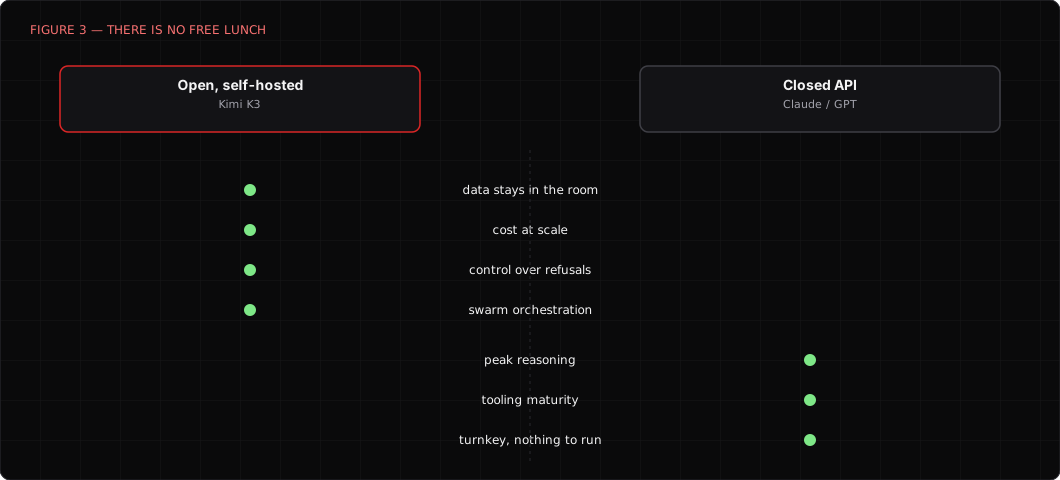
The capability gap is real at the top. On the hardest reasoning, the most subtle code analysis, and the tasks that need the model to hold a huge, tangled problem in its head, the best closed models from Anthropic and OpenAI still tend to have an edge. For a lot of security work the gap does not matter, because the work is more about breadth and tool use than deep reasoning. But when you need the single smartest possible read on a hard problem, the frontier closed models are frequently still the sharper instrument, and pretending otherwise to make the open model look good helps no one.
You inherit the operational burden. Self hosting a large mixture of experts model is not free in effort or hardware. You need serious GPU memory, you own the deployment, the patching, the scaling, and the babysitting. The moment something breaks at 2am, there is no vendor to page. You traded a dependency for a responsibility, and that responsibility has a real cost in people and machines.
Trust the weights, or verify them. When you download model weights, you are running an enormous binary artifact from a supply chain you did not audit. The provenance of open weights matters, and "it was on a popular model hub" is not a security control. Treat model weights with the same supply chain suspicion you would give any other large third party binary you are about to run against sensitive data.
Hallucination is dangerous in this domain specifically. Every model makes things up, but in security work a confident fabrication is worse than useless. A model that invents a vulnerability that is not there, or worse, misses one that is, and states either with total confidence, will burn your credibility with a client fast. This is not unique to Kimi, but the discipline of verifying model output against reality is non negotiable for any model doing security work, and the more you automate with a swarm, the more places a confident hallucination can hide.
How to actually evaluate this for your team
Here is the framework I would use instead of trusting anyone's leaderboard, including mine.
Build a small, private evaluation set drawn from the real work. Twenty or thirty tasks that look like what your team actually does: summarize this recon output and flag what matters, review this snippet for the security bug, turn these findings into the first draft of a report section, plan an approach to this scenario. Then run every model you are considering against that set and score them on the things you care about.
For security work, the axes worth scoring are not the usual ones:
- Accuracy under pressure. How often does it get security details right, and how often does it confidently invent them. In this domain the false positives and the confident misses cost you the most.
- Tool use and agentic reliability. Can it use tools correctly, recover when a tool fails, and stay coherent across a long chain of actions. This matters far more than trivia recall for automation.
- Refusal behavior on authorized work. How often does it get in the way of legitimate, in scope tasks. A model that constantly second guesses your authorized work is a tax on every engagement.
- Structured output you can trust. Will it reliably produce the clean, parseable results a swarm needs to hand between agents, or does it drift out of format and break the pipeline.
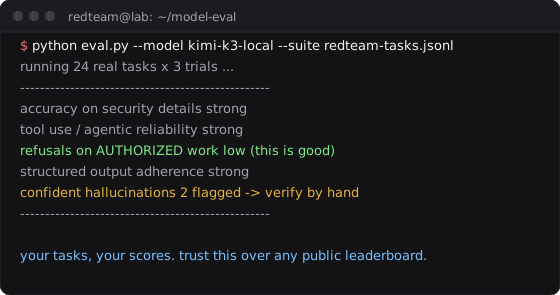
Run that eval, and the choice usually makes itself. If your work demands that data never leave a controlled environment, an open self hosted model is not a preference, it is a requirement, and Kimi K3 is one of the strongest options in that category right now. If you are doing occasional, non sensitive analysis and you want the sharpest possible reasoning with zero operational overhead, a frontier closed model is still often the better tool, and there is no shame in using it.
The verdict
Kimi K3 and K3 Swarm are not interesting because they beat Claude or GPT on a leaderboard. On the very hardest reasoning they probably do not, and a good review should say so. They are interesting because they change what is possible operationally. An open, self hostable, agentic model that is strong enough to do real security work means a red team can keep its client's data inside the perimeter, run automation at a scale that metered pricing would make painful, coordinate a swarm across a broad scope, and never once worry about a vendor pulling the rug mid engagement. For a serious offensive team, those properties frequently matter more than the last ten percent of raw intelligence.
My actual recommendation is unglamorous: run both. Keep a frontier closed model for the moments you need the sharpest possible read on a hard, non sensitive problem, and stand up an open model like Kimi K3 for everything that has to stay in the room or run at scale. The teams getting the most out of this right now are not loyal to one lab. They are matching the tool to the constraint, engagement by engagement, and the constraint on real security work is very often about control, not cleverness.
That is the shift worth internalizing. For a long time the only question about an AI model was how smart it is. For security work, the more important question has quietly become how much of it you own, and that is a question the open models were always going to win.
Where to go next
- Build your private eval set. Twenty real tasks from your own engagements, scored across the axes above. This single exercise will teach you more than this entire article.
- Stand one up and self host it. Get an open weight model running locally with a modern inference server and feel the operational reality, the good and the annoying, for yourself.
- Prototype a small swarm. Wire up an orchestrator and two or three worker agents on a scoped, authorized task and see where the coordination helps and where it just multiplies the mistakes.
- Pressure test the output. Feed the model a scenario where the correct answer is "there is no vulnerability here" and see whether it agrees or invents one. How a model behaves when the honest answer is boring tells you a lot about whether you can trust it.
Further reading
- Moonshot AI's Kimi for the current model line and its documentation
- OWASP Top 10 for LLM Applications for the risk model around deploying these systems
- vLLM is a common way to actually serve a large open weight model with reasonable throughput
- NIST AI Risk Management Framework for thinking through the governance of any model you deploy for security work
A note on this review: model capabilities move faster than any article can keep up with, and nothing here should be read as a fixed benchmark score. Treat the specifics as a starting point and evaluate the current models on your own tasks. The figures are authored illustrations in this site's style, not captures of a specific tool. The judgment about where open self hosted models fit in offensive security is the part meant to outlast the version numbers.

Founder · Dr. Chaos
Aamir Lakhani is a leading senior security strategist responsible for providing IT security solutions to major enterprises and government organizations. He creates technical security strategies and leads security implementation projects for…